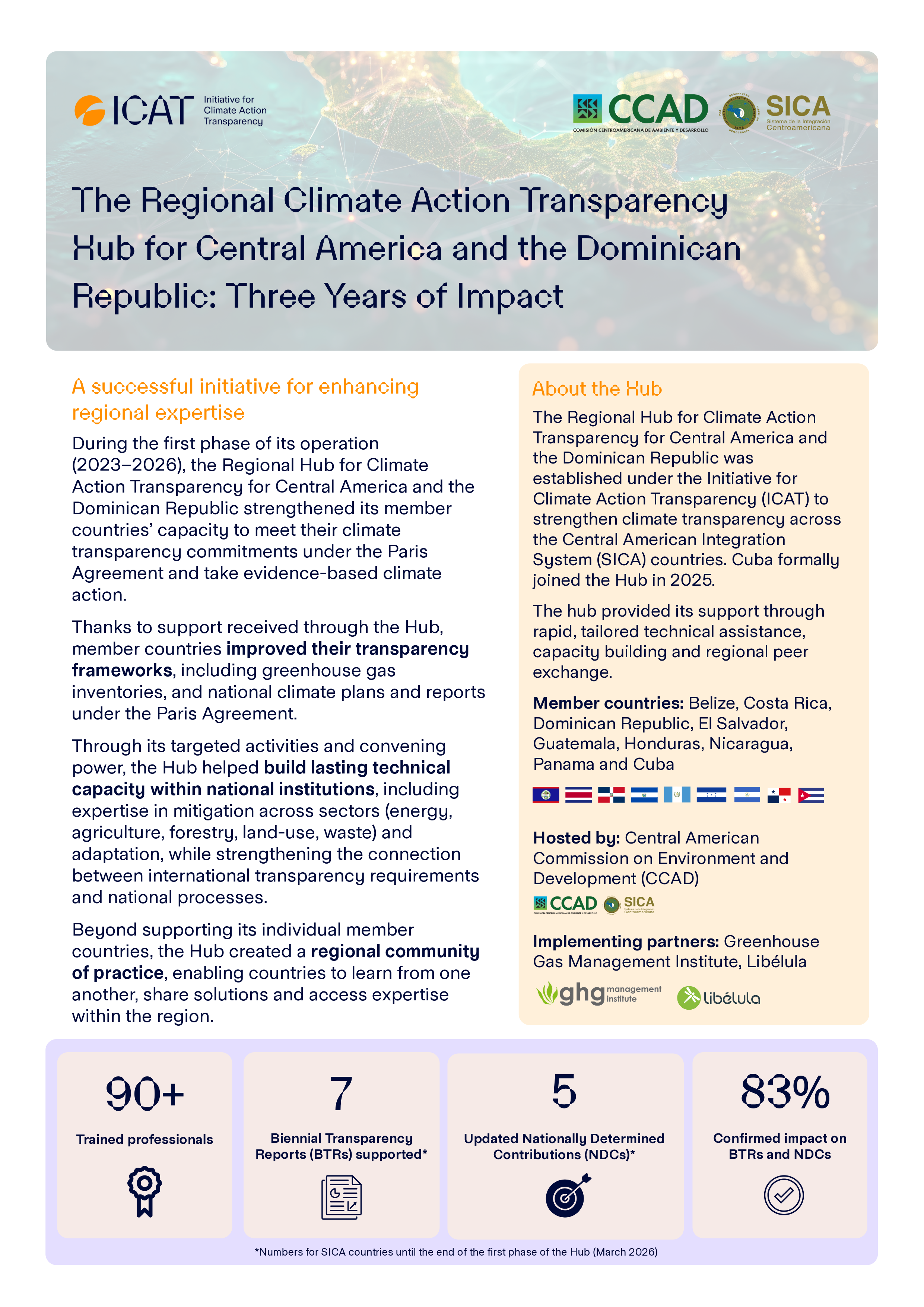
Across Central America, Cuba and the Dominican Republic, the Regional Hub for Climate Action Transparency helped countries strengthen their climate transparency systems and build technical expertise.
Established under the Initiative for Climate Action Transparency (ICAT) and hosted by the Commission for Environment and Development (CCAD) of the Central American Integration System (SICA), the Hub combined rapid, tailored technical assistance, capacity building and regional peer exchange opportunities.
During its first phase of operations (2023–2026), the Hub supported countries in strengthening national capacity, contributing to the preparation of Biennial Transparency Report (BTR) and to updates of Nationally Determined Contributions (NDCs), while creating a regional community of practice with the trust and connections to learn from and support one another.
A regional community built on shared expertise
One of the Hub’s most valued achievements in its first phase was the regional network of experts it created. Member country representatives had the opportunity to meet and exchange with colleagues from other countries, and learn from their experiences.
The Hub helped turn countries’ own experiences into a resource for others. “Each one is a champion in something” was a recurring message, highlighting the unique expertise that each country brought to the table. Through workshops, webinars, technical working groups and peer exchanges, countries shared insights, solutions and lessons learned.
Technical specialists built ongoing connections that fostered trust across the region. This created a network through which the Hub and national experts could provide support when particular challenges arose. The regional network became an important source of practical knowledge and assistance.
When technical support cannot wait
Member countries also consistently valued the Hub’s ability to respond quickly. Through the Hub, countries could receive technical guidance within days, when, under different circumstances, they would have had to wait months for an external consultancy.
This was particularly important as countries worked against reporting deadlines and tackled technical challenges. In Belize, for example, this rapid access to expertise supported the revision of the greenhouse gas inventory to improve accuracy.
Across the region, technical assistance covered diverse sectors and areas of expertise, including on specific sectors (energy, agriculture, forestry, other land uses, and waste), and on adaptation, greenhouse gas projections and NDC tracking.
Experts from the institutions providing technical support to the Hub’s work, the Greenhouse Gas Management Institute and Libélula, were available to guide countries according to international best practices and help them overcome obstacles.
Strengthening capacity to deliver on the Paris Agreement
Support delivered by the Hub contributed directly to countries’ core climate reporting and target-setting processes under the Paris Agreement. In all countries that received active assistance, this contributed to preparing or improving BTRs and/or updating NDCs.
By the end of the first phase, seven BTRs and five NDCs had been submitted across the Hub’s member countries. A participant survey found that 83% reported a direct impact of the Hub’s support on their BTRs and NDCs.
Practical resources, including QA/QC templates, NDC 3.0 templates, greenhouse gas projection tools and BTR roadmaps, were developed for countries to use. Equally important was the enhanced technical capacity of national experts, with expertise expanding from greenhouse gas inventories to NDC tracking, adaptation and climate finance.
What comes next for the regional Hub
The first phase of the Hub laid a strong foundation. However, continued support is needed to sustain ongoing technical assistance, preserve the regional network and respond to emerging priorities.
A potential second phase of the Hub would allow it to sustain ongoing support for NDC 3.0 implementation, greenhouse gas projections and vulnerability assessments. Countries have also identified climate finance, adaptation tracking, institutional arrangements and South-South cooperation as priorities. It has also been suggested that the Hub develop a regional roster of experts and play a stronger role in developing projects and accessing international climate finance.
The next phase could build on the strong foundation already established, strengthening the regional community and supporting countries as they advance climate action and implementation.
Read more about the impact of the Regional Climate Action Transparency Hub for Central America and the Dominican Republic.