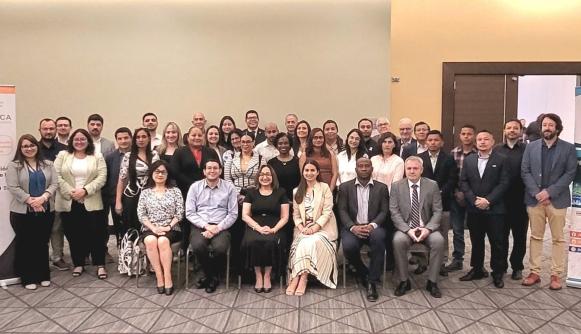
Dr Gervais Itsoua, Coordinator of the ICAT Regional Climate Action Transparency Hub in Central Africa, shares his insights on the Hub’s impact in the region.
Climate action depends on more than ambitious commitments. Countries need the institutions, expertise and information systems to turn those commitments into measurable action.
Across the 11 member states of the Economic Community of Central African States (ECCAS), the ICAT Regional Climate Action Transparency Hub is helping build this capacity. Its experience shows that progress requires more than training individual experts. It requires a regional community of practice through which knowledge, experience and solutions continue to circulate across borders.
From Training to a Community of Practice
From the outset, the Regional Hub set out to do more than train individual country officials and experts. It identified national specialists across Central Africa and created regular opportunities for them to work together through regional workshops, technical training, peer exchanges and thematic activities.
The result has been the emergence of a regional community of practice that brings together experts working on areas including greenhouse gas inventories, adaptation, mitigation and climate finance. Thematic technical working groups have provided a structure for collaboration beyond training events, helping build professional relationships, trust and a common technical language across countries.
The difference is significant. A workshop transfers knowledge; a community of practice creates relationships through which knowledge continues to be shared.
That network is already generating value that individual national programmes cannot easily provide. Countries do not have identical levels of expertise across all areas of climate transparency. Expertise available in one country can support learning and problem-solving in another. It also creates opportunities for countries facing similar challenges, from data systems and greenhouse gas projections to NDC tracking and climate finance, to learn from one another.
In practical terms, 11 countries do not need to solve the same technical problem 11 times.
Connecting Technical Expertise to Political Action
Climate transparency was once understood largely as a reporting obligation, focused on producing information for specific international reporting cycles. Increasingly, Central African countries are recognizing its broader strategic value for national planning, implementation and finance mobilization.
Building technical capacity for transparency matters because climate information can inform political decisions. As the intergovernmental organization bringing together 11 Central African states, ECCAS has been key to bridging the technical and political levels. The Regional Hub’s work has been part of discussions involving ministers, senior government officials and, in the case of the Democratic Republic of the Congo, even the Head of State*, creating a channel for technical progress to reach the highest levels of political decision-making.
In addition to the Hub’s engagement of ministries leading and contributing to the climate agenda, ECCAS’s established relationships with the region's ministries of foreign affairs have also helped keep climate transparency on the political agenda. Regional meetings have created a healthy form of peer pressure: when countries see that others are advancing on transparency, they are prompted to ask why similar progress is not being made at home.
The Hub's engagement at the annual UNFCCC Conference of the Parties (COP) has demonstrated the impact of this connection. At an annual event hosted by ECCAS, ministers meet with technical experts to discuss transparency, implementation and access to resources, while building credibility and trust among partners.
Making Climate Commitments Measurable and Investable
The same principle of transparency and credibility applies to national plans under the Paris Agreement, as reflected in countries’ Nationally Determined Contributions (NDCs). A commitment that cannot be measured or tracked is difficult to implement or finance.
The Regional Hub supported its member countries to meet their transparency obligations under the Paris Agreement and demonstrate their progress against their climate commitments through their first Biennial Transparency Reports (BTRs). It also expanded its work to support countries in strengthening their NDCs. Through the Hub, countries received tailored training in relevant data tools and were encouraged to establish indicators that allow NDC progress to be tracked.
This work extends the role of transparency beyond reporting, helping countries use reliable information to inform policy decisions, develop investment programmes, strengthen access to climate finance and track NDC implementation. This creates a practical chain between commitment, measurement, implementation and finance.
Looking at a few examples in the Hub’s member countries, Gabon has used strengthened transparency to demonstrate progress and build confidence among international partners. The Central African Republic is working to produce its first BTR to build greater confidence among development partners and help mobilize finance. And Burundi, Chad and Equatorial Guinea used an analytical tool provided through the Hub to develop mitigation targets for their latest NDCs.
Advancing Development and Climate Action Together
In the Congo Basin context, climate transparency has a particularly strategic role because it must help make both the region's contribution to global climate stability and its legitimate development needs visible.
Central Africa combines globally significant forest ecosystems with countries pursuing increased energy access, infrastructure improvements, economic growth and better livelihoods. For governments, climate transparency therefore has to answer a dual question: how can countries demonstrate their contribution to global climate goals while also making visible their legitimate development needs?
Reliable data and projections can help countries assess different development pathways in energy, agriculture, forestry, infrastructure and industry, while robust transparency frameworks can document emissions, removals and the impacts of climate policies, including in relation to the region’s forests.
The goal should not be to force a choice between climate ambition and development. Better information can help countries identify pathways that address both.
My own research on environmental diplomacy and climate finance mobilization in Central Africa found that the capacity to demonstrate needs, results and institutional readiness can be as important as natural assets themselves.
From External Expertise to Regional Ownership
Perhaps the most important transformation taking place through the Regional Hub is less visible than a new report, database or training certificate: it is a change in who is seen as the source of expertise.
Before the regional network was established, national experts sometimes lacked confidence in their own expertise, while there was an assumption that specialized knowledge had to come from outside the region. The community of practice is helping change that dynamic by giving national experts opportunities to share their experiences, solve problems together and recognize the expertise available within Central Africa.
Some of the most significant evidence of success has been seeing experts from different countries connect independently, share tools and help each other solve technical problems outside formal project activities.
That signals something important: knowledge is no longer flowing only from international consultants to individual countries. It is also circulating horizontally across the region.
The objective is not to replace international cooperation, but to make it more sustainable by strengthening the capacity of countries and regions to generate, retain and use their own expertise.
Looking ahead, the ambition is for Central Africa to build a critical mass of national experts, stronger data systems and functional institutions, supported by a sustainable regional network for peer learning and technical cooperation.
Ultimately, the success of climate transparency should be measured not simply by reports produced or experts trained, but by whether governments have the information and institutional capacity to make better decisions. The ECCAS Regional Hub shows that sustainable capacity depends not only on transferring knowledge, but also on creating the relationships and institutions through which it can be shared and applied.
*Speech delivered on 18 October 2022 by His Excellency Mr Félix-Antoine Tshisekedi Tshilombo, President of the Democratic Republic of the Congo and Chairperson-in-Office of ECCAS, on the occasion of the 3rd edition of Central Africa Regional Integration Day.