
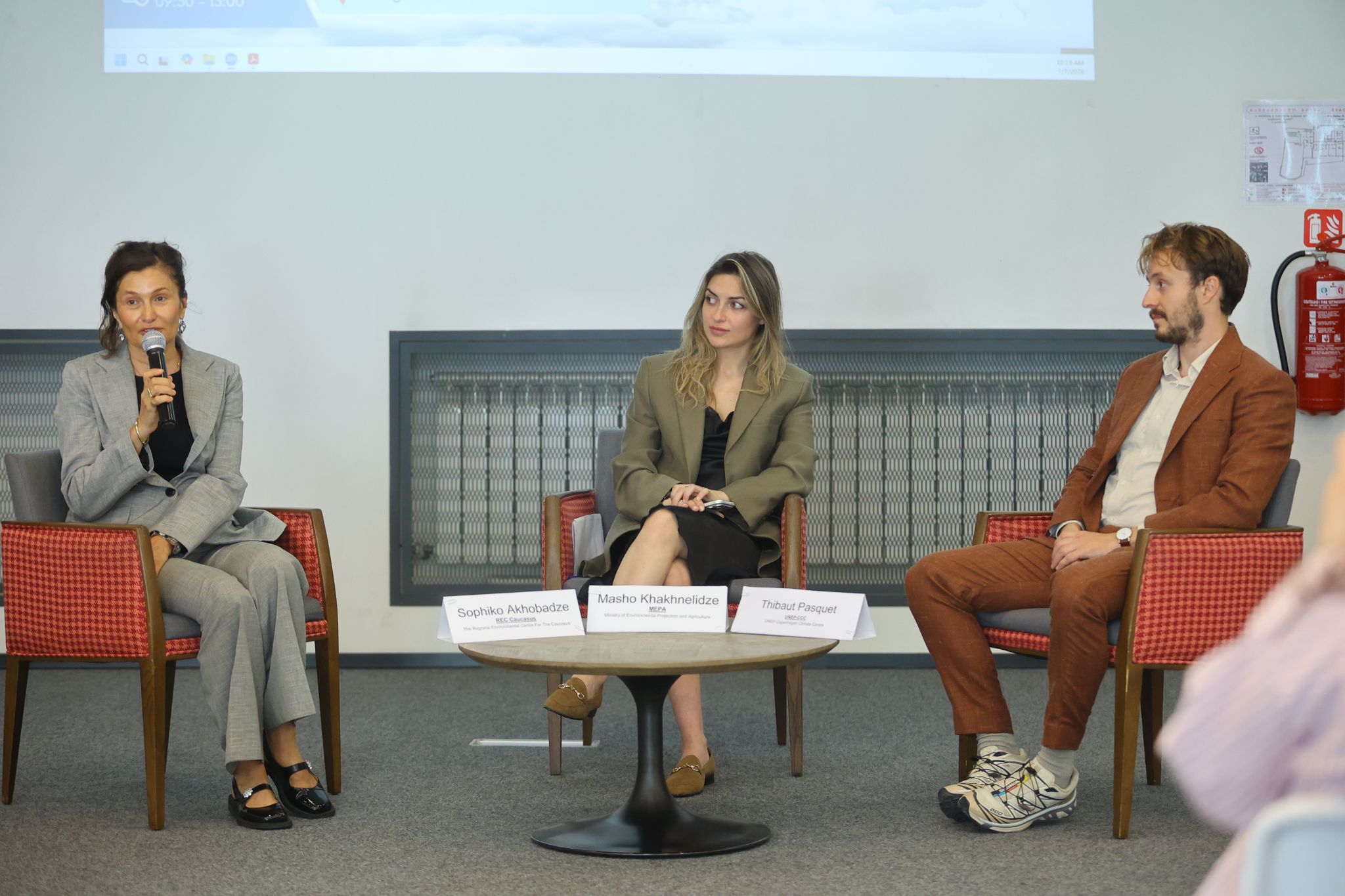
A new project aimed at supporting Georgia in implementing its Nationally Determined Contributions (NDC) 3.0 was officially launched on 7 July 2026 in Tbilisi. The event, held in a hybrid format, brought together representatives from Georgia’s Ministry of Environmental Protection and Agriculture (MEPA) and other key stakeholders, including sectoral ministries, NGOs, and academia.
MEPA is leading the project, with support from implementing partners, the Regional Environmental Centre for the Caucasus (REC Caucasus) and the UNEP Copenhagen Climate Centre. The project will support Georgia in implementing its NDC by updating two core strategic climate action instruments, the National Climate Strategy and Action Plan, and by developing an institutional framework to track NDC actions.
Strengthening Georgia’s NDC tracking capacity
Throughout the project, Georgia will adapt and apply the Greenhouse Gas Abatement Cost MOdel (GACMO) to aggregate and evaluate mitigation actions across sectors, based on their cost-effectiveness and greenhouse gas emission reduction potential. The project will map and analyze mitigation measures in all sectors, including transport, buildings, energy generation and transmission, agriculture, industry, and waste management, reflecting the breadth of Georgia’s NDC 3.0 commitments. Initial project activities will focus on mapping and analyzing priorities across all sectors, laying the foundation for an overarching NDC tracking framework. In addition, the project will support the assessment of greenhouse gas outcomes for selected priority policies and measures.
“This project represents an important step in strengthening Georgia's climate governance. [...] Effective monitoring, reliable data, and strong coordination across sectors are essential to delivering on Georgia's NDC and the goals of the Paris Agreement.” - Masho Khakhnelidze, Head of the Climate Change Division, Ministry of Environmental Protection and Agriculture of Georgia
The project will develop and implement NDC tracking frameworks through sectoral working groups. The project will include activities to enhance the capacity of national experts and government representatives to implement the Enhanced Transparency Framework (ETF) of the Paris Agreement and use transparency tools and frameworks for climate action planning.
Reliable transparency data is also expected to support Georgia’s climate finance strategy, helping determine financing needs, track financial flows, estimate funding gaps, and strengthen the country’s position to attract international and private finance.
“We believe these efforts will reinforce Georgia's transparency system and help lay the foundation for more ambitious climate action in the years ahead." - Sophiko Akhobadze, Executive Director, REC Caucasus

Building national ownership
At the workshop, participants were encouraged to treat the project as a participatory process. Establishing strong national ownership was highlighted as essential for ensuring the long-term implementation of Georgia’s climate vision. Stakeholders were invited to reflect from the outset about how the tools and frameworks developed through the ICAT project could be sustainably embedded into national institutional processes.